Pyramids, copper and electroculture

Glad you're here. On Cugenix we tell you where pyramids, copper and electroculture come from, what they are and how people work with them: at home, in the garden or in a quiet spot of your own. Calmly, and with the history included.

PyramidsElectrocultureCopper

Where it began

The pyramid is a shape that has occupied people for thousands of years. The Great Pyramid of Giza is about 4,500 years old, with a base of more than 755 feet and faces rising at almost 52 degrees. You still find those proportions in the small Cheops pyramid people place on a windowsill or in the garden. We find the story behind it at least as beautiful as the shape itself: who measured it, who started experimenting with it, and what remains of that. That's what we tell you here.

About Cugenix


At home and in the garden

Where people place a pyramid

Copper Russian pyramid with patina among the vegetables in a garden

In the garden

Many gardeners place copper pyramids and antennas among their vegetables and flowers. In doing so they build on the electroculture of around 1900. The Finnish physicist Selim Lemström strung wires over his fields and wrote that the crops beneath them yielded considerably more. At electroculture you can read what they do, and how to start yourself.

Copper Russian pyramid on a wooden sideboard, next to an amethyst

At home

A pyramid can simply be beautiful, too. On a windowsill, a sideboard or a shelf, with a plant or a few crystals beside it, it becomes a spot in your home you love to look at. Copper goes well with wood and natural materials, and over the years it takes on its own color. In pyramid materials you can read what each material brings.

Copper pyramid on a linen cushion, seen from above

A quiet spot

Some people place a pyramid as a fixed point for meditation, or simply to sit still for a while. Patrick Flanagan, who made pyramid power widely known in the 1970s, wrote that meditating under a pyramid comes more easily. At pyramids you can read how to choose one and where to place it.

Electroculture

Copper in the garden

Electroculture antenna of copper wire around a wooden stake, among the vegetables

The copper antenna

A wooden stake, a length of bare copper wire and a coil on top: that's how gardeners made their antennas in the 1920s, and that's how they still do it. You can make one yourself in half an hour. How, you can read at how to make an electroculture antenna.

Copper coil with patina in a vegetable garden, between lettuce and tomatoes

The copper coil

The coil goes back to the open copper ring Georges Lakhovsky placed around a geranium in 1925. Gardeners now place it around or next to their plants, outdoors and indoors. Where electroculture comes from, from Bertholon in 1783 to today, you can read at electroculture.

Wooden pyramid with a copper top in the middle of a vegetable garden

Weighed ourselves

In 2026 beets, celery and squash grew under and next to a pyramid for a whole season. With the beets and the celery, the harvest under the pyramid was more than twice as large. Read how the garden trial went.

The material

Copper, shape and time

Copper at 99.1%

Solid copper up close, with the fine lines of grinding

Our copper pyramids are made of solid copper with a copper content of 99.1%. Copper bends beautifully, conducts well, and has always been the material of electroculture. Why copper in particular, you can read under copper.

The proportions

Copper Russian pyramid next to a copper Cheops pyramid

A Cheops pyramid is broad and low, with the slope of Giza. A Russian pyramid is narrow and tall, about twice as tall as it is wide. Which one you choose depends mostly on where it will stand. Read more on the Cheops pyramid and the Russian pyramid.

Lacquered or unlacquered

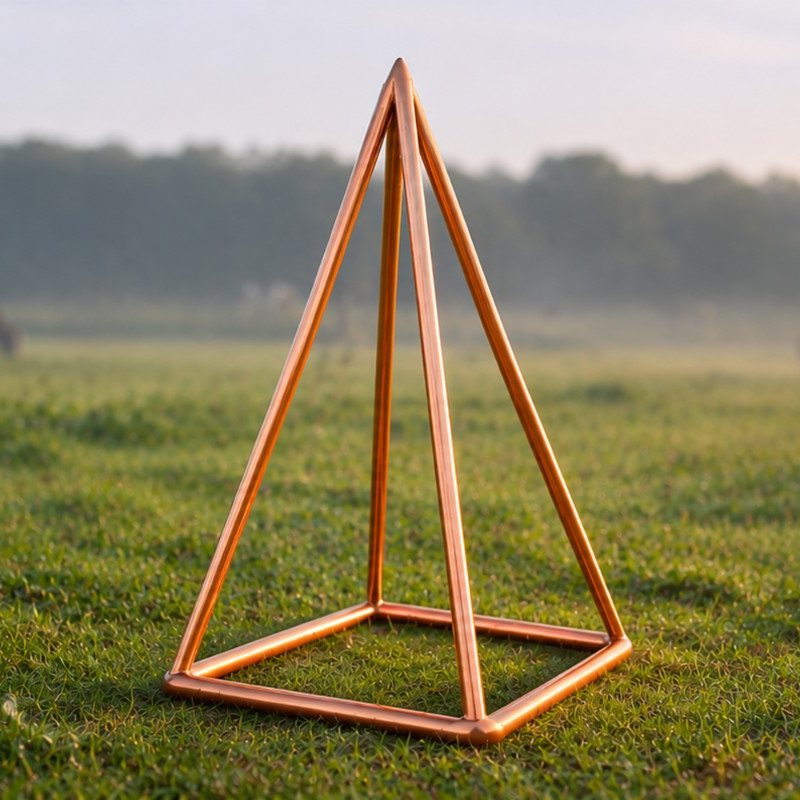
Bright copper pyramid in a meadow in the morning sun, with cows in the distance

Lacquered copper keeps its shine. Unlacquered copper slowly turns brown, and outdoors green after a while. That patina belongs to the material. You can leave it, or polish it off if you want the shine back.

New to pyramids?

Start with the shape

New to pyramids? Start with the two shapes, the measurements and where to place one. After that, the rest falls into place by itself.

All about pyramids

Slender copper pyramid on a wooden sideboard in the evening sun

About Cugenix

Who is behind Cugenix

Cugenix is a knowledge platform by Meditech Europe. The company has been selling copper pyramids, antennas and crystals since 2003, and has been a family business since 2019. Over all those years we have looked into a great deal, and customers have asked us a lot. We share that here. You can't buy anything here.

Frequently asked questions

What people often ask us

Wooden meditation pyramid with a copper top and a cushion underneath, in a quiet room

What is a copper pyramid?

An open frame of copper rod or tube in the shape of a pyramid, usually in the proportions of the Great Pyramid of Giza or in the steeper Russian shape. There are no electronics in it and no loose parts. It is all about the shape and the material.

What is the difference between a Cheops and a Russian pyramid?

The Cheops pyramid follows Giza: broad, with faces rising at about 52 degrees. The Russian pyramid is much steeper, about twice as tall as it is wide. That shape comes from the large pyramids the engineer Alexander Golod had built in Russia from the 1990s onward.

Why copper?

Copper bends easily, conducts well and takes on a beautiful color over time. People have been working with it in electroculture for more than a hundred years.

Lacquered or unlacquered: which should I choose?

If you want it to keep its shine, choose lacquered. If you love the change in color, or it will stand outdoors, unlacquered suits better: that copper takes on its own color over time.

Where can I buy a pyramid?

We don't sell anything here ourselves. The pyramids you read about on this site are at Meditech Europe. Living in the US? We ship there on request, just send us a message.