
Electroculture Gardening: Copper in the Garden
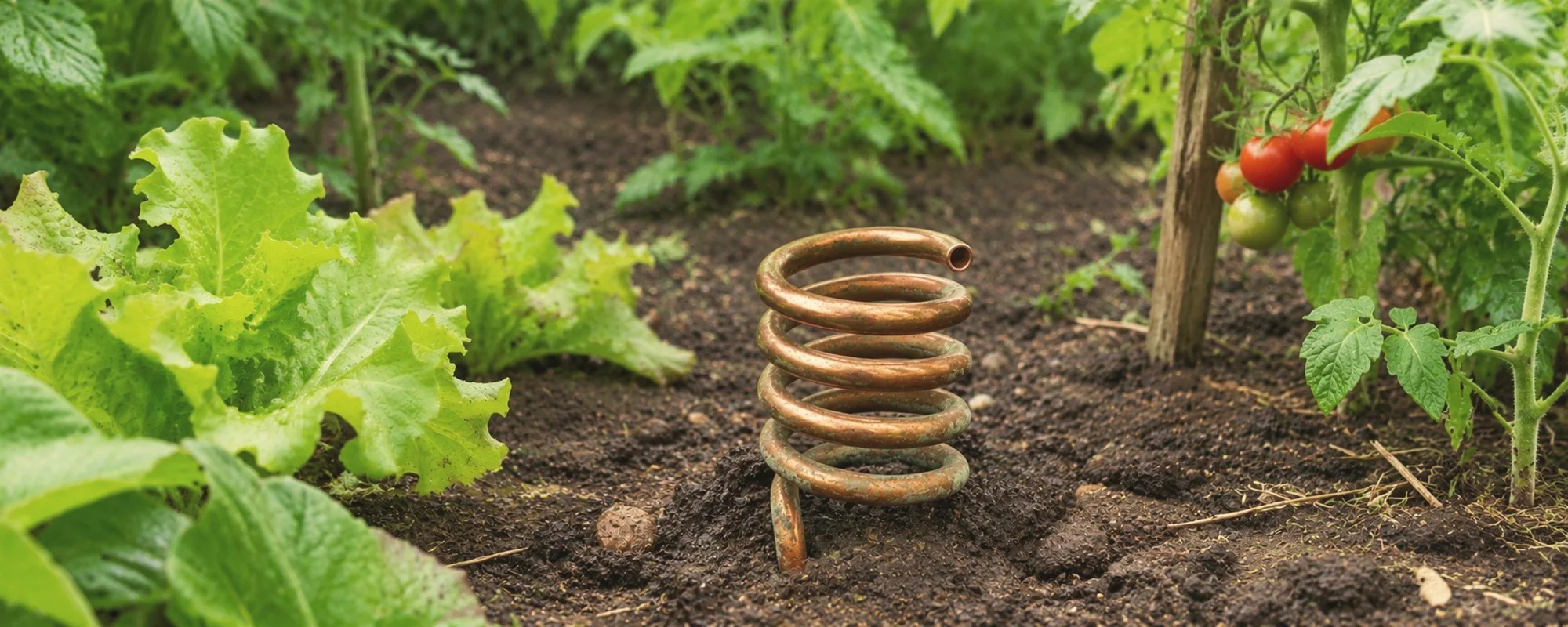
Electroculture is the idea that the electricity naturally present in air and soil helps plants grow. Gardeners work with it using copper antennas, wires in the ground and pyramids among the plants. It sounds new, but it is more than two hundred years old. Here you can read where it comes from, what researchers found and how to start electroculture gardening yourself.
Where it began: Bertholon, 1783
In 1783 the French physicist Pierre Bertholon wrote a book about electricity and plants: De l'électricité des végétaux. He built a device to go with it, the électrovégétomètre: a metal rod with points that collected electricity from the air and led it to the plants. Bertholon was convinced that this electricity promotes growth.
Selim Lemström and the northern lights
More than a hundred years later the Finnish physicist Selim Lemström took up the idea again. Lemström was a professor in Helsinki who studied the northern lights. He noticed that trees in the far north grew more strongly in years with many northern lights, and explained it by the electricity in the air. From 1885 he spent seventeen years experimenting with grains, potatoes, carrots and strawberries, using electricity from a generator. According to a review in the journal Acta Horticulturae (1973), dry weight increased by 60 percent in grains and by 183 percent in carrots. He described his findings in 1902 in the book Elektrokultur. In 1904 it appeared in English: Electricity in Agriculture and Horticulture.
Justin Christofleau and his antennas
In the 1920s the Frenchman Justin Christofleau brought electroculture to ordinary gardeners. He applied for some forty patents, including one for an "electromagnetic bell" (1927), and in 1923 wrote a book about larger harvests through electroculture. Christofleau worked with antennas that collected electricity from the air and led it into the ground, with no outside power. On April 26, 1930 he had his crops recorded by a bailiff: wheat with leaves up to 29 inches (73 centimeters) and a cabbage more than six and a half feet (two meters) across.
Georges Lakhovsky and the copper coil
In the same years the engineer Georges Lakhovsky, who had come to France from Russia, was working in Paris. He believed that everything alive vibrates, and that an open circuit of copper can pick up that vibration. To show it, he ran an experiment in Paris with geraniums. In December 1924 he infected them with a bacterium that causes tumors on the stem. In early January 1925 he placed an open ring of copper around one plant, about a foot (30 centimeters) across, with ends that did not touch. According to Lakhovsky, the other geraniums were dead after a few weeks, while the plant with the ring kept growing. Three years later it was four and a half feet (1.40 meters) tall. He described the experiment in his book Le Secret de la vie (1929), published in English as The Secret of Life.
That open ring is where the copper coil comes from that many gardeners now place around or next to their plants, in the vegetable garden and indoors. It is often called the Lakhovsky coil.
Government research
Governments took it seriously too. The British Ministry of Agriculture had it studied from 1918 to 1936 by a special committee, the Electro-Culture Committee. In France, researchers ran experiments with positive results between 1918 and 1925.
Research today
In 2022 a Chinese study appeared in the scientific journal Nature Food. The researchers grew peas in a greenhouse, some of them in an electric field. They generated that field with a small device powered by wind and rain, costing about forty dollars. The peas in the electric field yielded about a fifth more.
Measurements are made without power too. In Nigeria, researchers in 2025 placed copper antennas next to okra plants, with no power source at all. The twelve plants with an antenna produced 156 pods together, against 67 for the six plants without, more than twice as many per plant.
What electroculture gardeners do now
Most gardeners, like Bertholon and Christofleau, work without a power source. They use copper:
- Antennas. A copper wire, often wound in a spiral around a wooden stake, standing upright among the plants. How to make one yourself, you can read at how to make an electroculture antenna.
- Coils. A coil of copper tube or rod, around or next to a plant in the ground or in a pot. It is the shape that goes back to Lakhovsky's ring.
- Copper wire in the ground. Copper wire laid in the soil between the rows.
- Pyramids. A pyramid of copper or wood over or next to the plants. In our garden trial they were wooden pyramids of Douglas fir.

Copper is the standard material: it conducts well, doesn't rust and is easy to bend. You'll find antennas and other electroculture supplies at Meditech Europe, in the electroculture category, such as the copper plant spiral. Living in the US? We ship there on request, just send us a message.
Our garden trial
In 2026 we grew beets, celery and squash under and next to a pyramid for a whole season. With the beets and the celery, the harvest under the pyramid was more than twice as large. Read how the garden trial went.
Getting started
You can make an antenna yourself in half an hour, with a wooden stake and bare copper wire. How to do it, with a drawing, is at how to make an electroculture antenna. Then compare like this:
- Choose two beds with the same soil and the same sun.
- Put a copper antenna or a pyramid in one bed, and leave the other bed without.
- Sow or plant the same crops in both beds, on the same day.
- Keep track of what you see and take photos.
- At the end of the season, weigh the harvest from both beds.
After one season you'll know what it does in your garden. We'd love to hear what came out of it: see join in.
Frequently asked questions
Does electroculture work?
Researchers have measured it more than once. Selim Lemström reported up to 183 percent more dry weight in carrots, a Chinese study in Nature Food (2022) found peas yielded about a fifth more in an electric field, and in a 2025 okra trial in Nigeria plants with only a copper antenna produced more than twice as many pods. The easiest way to see what it does in your own garden is to compare two beds.
What is electroculture?
Using the natural electricity in air and soil to help plants grow, usually with copper antennas, wires or pyramids. The idea goes back to Pierre Bertholon in 1783.
Does electroculture work without power?
Bertholon and Christofleau worked without a power source, with rods and antennas that collected electricity from the air. Lemström and the Chinese researchers of 2022 generated an electric field themselves. In the okra trial from Nigeria (2025) there were only copper antennas, no power, and the plants produced more than twice as many pods.
Who was Selim Lemström?
A Finnish physicist (1838–1904) who studied the northern lights. From 1885 he experimented with grains and carrots, among other crops, with up to 183 percent more dry weight, and wrote the book Elektrokultur about it in 1902.
What material do you use for electroculture?
Almost always copper: copper wire for antennas and wires in the ground, copper tube or rod for coils, and copper or wood for pyramids. Copper conducts well and doesn't rust.
What is a Lakhovsky coil?
An open ring or coil of copper, named after the engineer Georges Lakhovsky. In the 1920s he placed such an open copper ring around geraniums. Gardeners now place the coil around or next to their plants, outdoors and indoors.

Written by Marijn Makkes van der Deijl, who has been working with copper and pyramids since 2019.
Sources
- Bertholon, P. (1783). De l'électricité des végétaux.
- Lemström, S. (1902). Elektrokultur. Erhöhung der Ernte-Erträge aller Kulturpflanzen durch elektrische Bestrahlung. Berlin: W. Junk.
- Zurbicki, Z. (1973). Atmospheric electricity and plant nutrition. Acta Horticulturae 29, 413–428.
- Lemström, S. (1904). Electricity in Agriculture and Horticulture. London.
- Christofleau, J. (1923). Augmentation des récoltes et sauvetage des arbres malades par l'électroculture. La Queue-les-Yvelines.
- Lakhovsky, G. (1929). Le Secret de la vie: ondes cosmiques et radiation vitale. Paris: Gauthier-Villars. English edition: The Secret of Life (1939). London: Heinemann.
- Blackman, V. H. (1924). Field experiments in electro-culture. Journal of Agricultural Science 14, 240–257.
- Atanda, A. O. et al. (2025). Effects of electroculture antennas on okra growth and yield performance. IKR Journal of Agriculture and Biosciences 1(4), 229–237.
- Li, X. et al. (2022). Stimulation of ambient energy generated electric field on crop plant growth. Nature Food 3.
Last updated: November 2026