
Pyramid Power: What Has Been Studied?
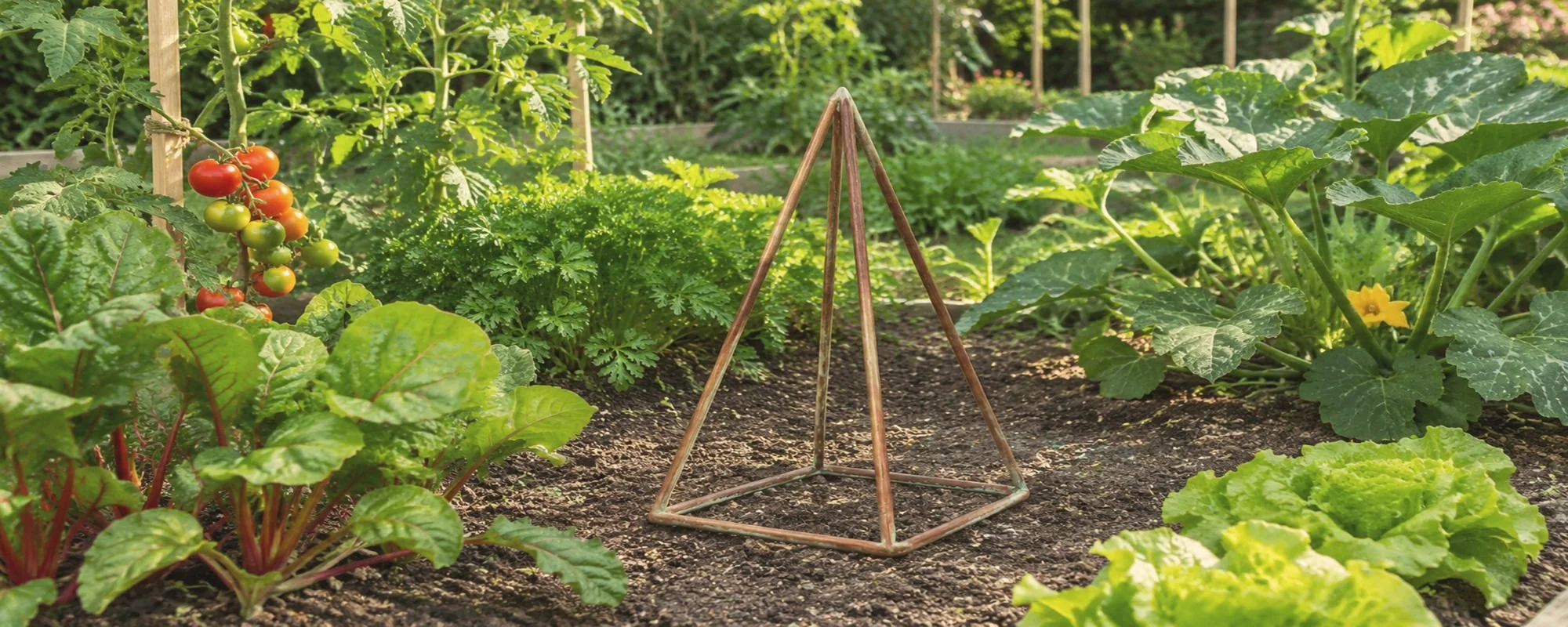
If you have a pyramid at home, sooner or later someone asks: what does a shape like that actually do? The answer is a story that begins in the 1930s and runs through a Czech patent and a few American books to researchers in India and Russia. Here you can read what was measured, by whom, and how you can try it yourself.
At a glance: what was measured
| Year | Who | What | What they found |
|---|---|---|---|
| 1949 | Karel Drbal, Czechoslovakia | Razor blade under a cardboard pyramid | On average more than a hundred shaves with one blade (patent 91304) |
| 2003–2009 | Surekha Bhat et al., Manipal (India) | Rats under a wooden pyramid | Different values in the blood; facing north mattered |
| 2008 | Gopinath et al., Bangalore (India) | Milk kept 14 days under pyramids | Fewer bacteria; wood worked best, octagonal better than square |
| 2010 | Kumar et al., Bangalore (India) | Fenugreek under a pyramid | Faster root growth and stronger seedlings |
| 2010–2017 | Takagi et al., Japan | Cucumber slices as a sensor on top | Measurable effect on top, stronger in summer |
| 2011 | Beverly Rubik and Harry Jabs, USA | Pole beans under a wooden pyramid | 19 percent more weight, larger leaves |
| 2012 | Vasavada and Gadani, Ahmedabad (India) | Four kinds of seed under a cardboard pyramid | After three days 82 versus 61 percent germinated |
| 2016 | Jungyun et al., Bangalore (India) | Mung beans under a plywood pyramid | Most germination, longest roots |
| 2018 | Kumar and Soni (India) | Mung beans under wooden and copper pyramids | Copper pyramid gave the best result |
| 2018 | ITMO University, Saint Petersburg | Computer model of the Great Pyramid | Radio waves concentrate in the chambers and under the base |
| 2019 | Fahmy et al., Cairo University | Rats with one kidney under a wooden pyramid | Remaining kidney worked better than in an ordinary cage |
| 2022 | Teng et al., China | Cells under a copper pyramid | Different values in the mitochondria, same growth |
Below you can read how each study was done.
A French pendulum and the Great Pyramid
The story begins with the Frenchman Antoine Bovis. According to the story that has been passed on ever since, he saw dead animals in the Great Pyramid of Giza that had not decayed. Bovis worked with a pendulum and small cardboard pyramids, and came to the idea that the shape could preserve meat and fish. With that, the idea of pyramid power was born.
Karel Drbal's razor blade
In 1949 the Czech Karel Drbal applied for a patent on what he called the "Pharaoh's shaving device": a small pyramid under which a razor blade stays sharp longer. His patent says that this way he could shave more than a hundred times on average with one blade, with the blade facing north–south. According to Drbal, the earth's magnetic field played a part. The patent got number 91304 and was published in 1959.
How pyramid power became a household term
In 1970 Sheila Ostrander and Lynn Schroeder published Psychic Discoveries Behind the Iron Curtain, which covered both Bovis and Drbal. Shortly afterward two books appeared with the same title, Pyramid Power: one by Patrick Flanagan and one by Max Toth. Flanagan wrote that plants grew better under a pyramid and that water came to taste different. From then on, the pyramid as a shape of energy was a household term.
Experiments with animals and food
The most-cited research comes from Manipal, in southern India. In 2003 four researchers led by the biochemist Surekha Bhat placed rats under a wooden pyramid, in the proportions of the Great Pyramid, for six hours a day over two weeks. They compared them with rats in an ordinary cage and with rats under a cube-shaped box of about the same size. That box is the clever part of the experiment: it rules out that the effect is only about shelter.
In the animals under the pyramid the researchers measured different values in the blood than in the animals without a pyramid. Between the ordinary cage and the cube they saw no difference.
The same group then ran two follow-up experiments. In 2007 they turned the pyramid away from north, and in their measurements part of the difference disappeared. So in their experiment the orientation of the pyramid mattered. In 2009 they left the animals under the pyramid for four weeks instead of two. In another experiment, published in 2007 in the journal Evidence-Based Complementary and Alternative Medicine, the rats spent six hours a day in a confined space, with and without a pyramid, and again with a square box beside it. In the rats under the pyramid, the blood values stayed close to those of rats that simply stayed in their cage. Under the box they did not.
In 2019 researchers from the Department of Zoology at Cairo University built a wooden pyramid 76 centimeters (30 inches) tall, with a base of 114 centimeters (45 inches). They studied what it does in rats that had one kidney removed. They divided the 42 rats into three groups: one without surgery, one after surgery in an ordinary cage, and one after surgery under the pyramid for six hours a day. After 48 hours, according to the researchers, the remaining kidney worked better in the rats under the pyramid than in those in the ordinary cage. They conclude that time spent in a pyramid can soften the effects of such an operation.
In Bangalore, researchers in 2008 kept milk for fourteen days under pyramids of wood and of fiberglass, square and octagonal. In all samples under a pyramid fewer bacteria grew than in the milk beside them. The wooden pyramids kept the milk best, and the octagonal ones did better than the square ones.
In 2014 Malaysian researchers studied whether a pyramid shape could help keep food fresh longer, as packaging that needs no refrigeration. Their study appeared in a scientific conference volume.
A copper pyramid in the laboratory
In 2022 Chinese researchers at the ENNOVA Institute placed cells under a copper pyramid for a day and a night, with a base and a height of 28 centimeters (11 inches). They compared them with the same cells in a space without a pyramid. Under the pyramid they measured different values in the mitochondria, the power plants of the cell. Cell growth stayed the same. The researchers themselves describe the effect as gentle, without strong or extreme influence.
Experiments with plants
In 2011 the American biophysicist Beverly Rubik and Harry Jabs ran an experiment with pole beans in a laboratory. They divided 24 beans into four groups and placed some under a wooden pyramid of four feet (1.2 meters), with two sides facing north. Light, temperature and water were the same for all groups. After a month the group under the pyramid weighed 19 percent more than the control group, and the leaves were larger: about 2 inches against 1.4. In the same experiment, a group of more than fifty people sent a conscious intention to the plants from a distance. With that intention alone the harvest weighed almost 23 percent more, with intention and pyramid together more than 31 percent. Rubik therefore sees the pyramid as a shape that amplifies intention.
In India, researchers in 2016 germinated mung beans under a plywood pyramid of 15 by 15 centimeters (6 by 6 inches), with one side facing north, in ten rounds of forty seeds. Under the wooden pyramid the most seeds came up and the roots grew longest. Earlier, in 2010, researchers from the same institute saw faster root growth and stronger seedlings in fenugreek under a pyramid. And in an experiment with mung beans under pyramids of wood and copper, the copper pyramids gave the best result, and large pyramids more than small ones.
Biologists at St. Xavier's College in Ahmedabad in 2012 germinated peas, chickpeas, mung beans and moth beans under a cardboard pyramid in the proportions of Giza, with a pot without a pyramid beside it. After one day 17 percent of the seeds under the pyramid had come up, and none yet in the control pot. After three days it was 82 against 61 percent. Mung beans responded most strongly: 78 against 43 percent.
In Japan, researchers measured on top of a pyramid 3.5 feet (1.07 meters) tall for seven years, from 2010 to 2017, using cucumber slices as a natural sensor. They compared them with slices 26 feet (eight meters) away. In 468 measurements they found a measurable effect on top, stronger in summer than in winter. They published a series of eight papers on it in the journal Natural Science.
The shape and waves
In 2018 physicists at ITMO University in Saint Petersburg published a study in the Journal of Applied Physics that went around the world. Using a computer model they showed that the Great Pyramid can capture radio waves 200 to 600 meters long and concentrate that energy in its chambers and under its base, exactly where the third, unfinished chamber lies. It comes from the shape and the dimensions of the pyramid together. The researchers want to use that knowledge for tiny pyramid-shaped particles in solar cells and sensors.
That the pyramid shape does something with waves has long been known in engineering. In silicon solar cells, microscopically small pyramids are etched into the surface because they catch light better: the light bounces back and forth a few times before it can escape. Researchers at Georgia Tech calculated in 1993 that inverted pyramids trap light best. And researchers at AMOLF in Amsterdam and Philips showed in 2014 that pyramid-shaped nano-antennas send light of different colors in opposite directions.
Why people place a pyramid
People who work with pyramids rarely do so because of a study. A pyramid is a shape that has made people pause for more than four and a half thousand years. Some use it in meditation, as a fixed point for attention. Others place it among their plants, on their desk or on the windowsill. The Cheops pyramid remains the model: a slope of about 51.8 degrees, a base of 756 feet (230 meters) and an original height of more than 480 feet (146 meters).
Try it yourself
If you're curious, do what Bovis did, but with a comparison. Take two equal pieces of fruit. Put one under a pyramid and the other under a box of the same size, in the same spot. Have someone else place them, so you don't know which piece is where, and look after a week. That's how researchers do it too. You'll find a pyramid in the proportions of Giza at Meditech Europe: the copper Cheops pyramid. Living in the US? We ship there on request, just send us a message. Want to make one yourself? Use the pyramid calculator.
Frequently asked questions
What is pyramid power?
That is the name for the idea that the shape of a pyramid does something to what lies or stands beneath it. It began with Antoine Bovis in the 1930s, got a patent with Karel Drbal in 1949 and became known as pyramid power in the 1970s.
Does pyramid power work?
Researchers in India, Egypt, Japan, China and the United States have measured differences under pyramids, in seeds, milk, cells and animals. Who measured what, and how, is in the table at the top of this page. You can also test it yourself with two pieces of fruit and a box.
Does a pyramid have to face north?
In the tradition, yes: one side facing north, as at Giza. In the Indian experiments of 2007, part of the measured difference disappeared when the pyramid was turned.
Does the material matter?
The best-known experiments used wood or cardboard. People choose copper mainly for its look and because it lasts, and because copper has always been the material of electroculture.
What are the proportions of the Cheops pyramid?
The Great Pyramid of Giza has a slope of about 51.8 degrees. The height is about 0.64 times the length of one side of the base. With the calculator you can work it out for any size.

Written by Marijn Makkes van der Deijl, who has been working with copper and pyramids since 2019.
Sources
- Bhat, S., Rao, G., Murthy, K. D. and Bhat, P. G. (2003). Effect of housing rats within a pyramid on stress parameters. Indian Journal of Experimental Biology 41(11), 1289–1293.
- Bhat, S., Rao, G., Murthy, K. D. and Bhat, P. G. (2007). Influence of alignment of the pyramid on its beneficial effects. Indian Journal of Experimental Biology 45(5), 455–458.
- Bhat, S., Rao, G., Murthy, K. D. and Bhat, P. G. (2009). Effect of varying durations of pyramid exposure. Indian Journal of Clinical Biochemistry 24(4), 430–432.
- Bhat, M. S., Rao, G., Murthy, K. D. and Bhat, P. G. (2007). Housing in pyramid counteracts neuroendocrine and oxidative stress caused by chronic restraint in rats. Evidence-Based Complementary and Alternative Medicine 4(1), 35–42. doi:10.1093/ecam/nel049
- Fahmy, S. R., Gaafar, K., Sayed, D. A. and Nageeb, H. (2019). Ameliorative Efficacy of Egyptian Pyramid Model Housing on Unilateral Nephrectomized Rats. Biomedical Journal of Scientific & Technical Research 12(5). doi:10.26717/BJSTR.2019.12.002302
- Gopinath, R. K., Nagaraja, P. A. and Nagendra, H. R. (2008). The effect of pyramids on preservation of milk. Indian Journal of Traditional Knowledge 7(2), 233–236.
- Rubik, B., with contributions from Jabs, H. (2016). Interactions of pyramidal structures with energy and consciousness. Cosmos and History: The Journal of Natural and Social Philosophy 12(2), 259–275.
- Jungyun, J., Jeeye, P. and Kumar, I. R. (2016). Seed germination test with the influence of sriyantra, pyramid and maha mrtyunjaya mantra. Indian Journal of Traditional Knowledge 15(4), 680–684.
- Teng, J., Chen, Y., Chen, Y., Feng, Q., Wang, L., Li, M., Cai, Z. and Bai, X. (2022). The Influence of Pyramid Structure on Cells. Biomedical Journal of Scientific & Technical Research 41(1), 32296–32300.
- Kumar, I. R., Swamy, N. V. C., Nagendra, H. R. and Radhakrishna (2010). Influence of pyramids on germination and growth of fenugreek. Indian Journal of Traditional Knowledge 9(2), 347–349.
- Kumar, I. R. and Soni, P. (2018). Germination of green gram with influence of pyramid energy and lunar days. International Journal of Emerging Technology and Advanced Engineering 8(1), 81–87.
- Vasavada, S. and Gadani, M. (2012). Effect of pyramid on seed germination. Life Sciences Leaflets, 263–267.
- Takagi, O. et al. (2019–2023). Potential Power of the Pyramidal Structure I–VIII. Natural Science 11(8) to 15(4).
- Smith, A. W. and Rohatgi, A. (1993). Ray tracing analysis of the inverted pyramid texturing geometry for high efficiency silicon solar cells. Solar Energy Materials and Solar Cells 29, 37–49.
- Rodriguez, S. R. K., Bernal, F., Steinbusch, T. P., Verschuuren, M. A., Koenderink, A. F. and Gómez Rivas, J. (2014). Breaking the symmetry of forward-backward light emission with localized and collective magnetoelectric resonances in arrays of pyramid-shaped aluminum nanoparticles. Physical Review Letters.
- Abdelsamie, M. A. A., Rahman, R. A. and Mustafa, S. (2014). Pyramid Shape Power as a New Halal-compliant Food Preservation and Packaging Technique. Procedia – Social and Behavioral Sciences 121, 232–242.
- Balezin, M., Baryshnikova, K. V., Kapitanova, P. and Evlyukhin, A. B. (2018). Electromagnetic properties of the Great Pyramid: First multipole resonances and energy concentration. Journal of Applied Physics 124, 034903.
- Komarova, A. (July 31, 2018). Study reveals the Great Pyramid of Giza can focus electromagnetic energy. Phys.org / ITMO University.
- Drbal, K. Czechoslovak patent 91304, filed November 4, 1949, published August 1959.
- Ostrander, S. and Schroeder, L. (1970). Psychic Discoveries Behind the Iron Curtain. Prentice-Hall.
- Flanagan, G. P. (1973). Pyramid Power. Pyramid Publishers.
Last updated: November 2026