
What Are Pyramids Made Of?
The first pyramids were made of stone. Today you see them in copper, wood, glass, crystal and resin. Each material gives a pyramid its own character: one is light and open, another heavy and solid; one stays as it is, another changes over the years. Here you can read what each material brings, so you know what to look for.
Stone: where it began
The pyramids of Egypt were built of limestone, with granite for the heaviest parts. Those of Meroë in Sudan are sandstone, and in Mexico people built with earth and stone, finished with plaster. A stone pyramid is solid: no space inside except the passages and chambers the builders left open. What sets all those structures apart, you can read in pyramid shapes.
Copper: the most popular choice
If you are looking for a pyramid for your home or garden today, you'll mostly come across copper. Copper conducts better than almost any other metal, bends beautifully and takes on its own color over the years. It is usually an open frame: just the edges, so you can see through it and place something underneath. What goes into a copper pyramid, whether to choose lacquered or unlacquered, and how to care for it, you can read under copper.
Wood: warm, and easy to build big
Wood is the material for large pyramids. A frame of three feet or more quickly gets heavy and expensive in copper; in wood it stays easy to carry and to build. Wood also feels warm and suits a living room, a practice room or a garden.

Not every kind of wood lasts equally long. The European standard EN 350 rates wood by durability, from class 1 (longest-lasting) to 5. Teak is among the most durable, oak is in class 2 and Douglas fir in class 3 to 4. Indoors that makes little difference. If you put a wooden pyramid outdoors, oak or teak will last longer than Douglas fir, and it helps if the wood doesn't sit directly on the ground.
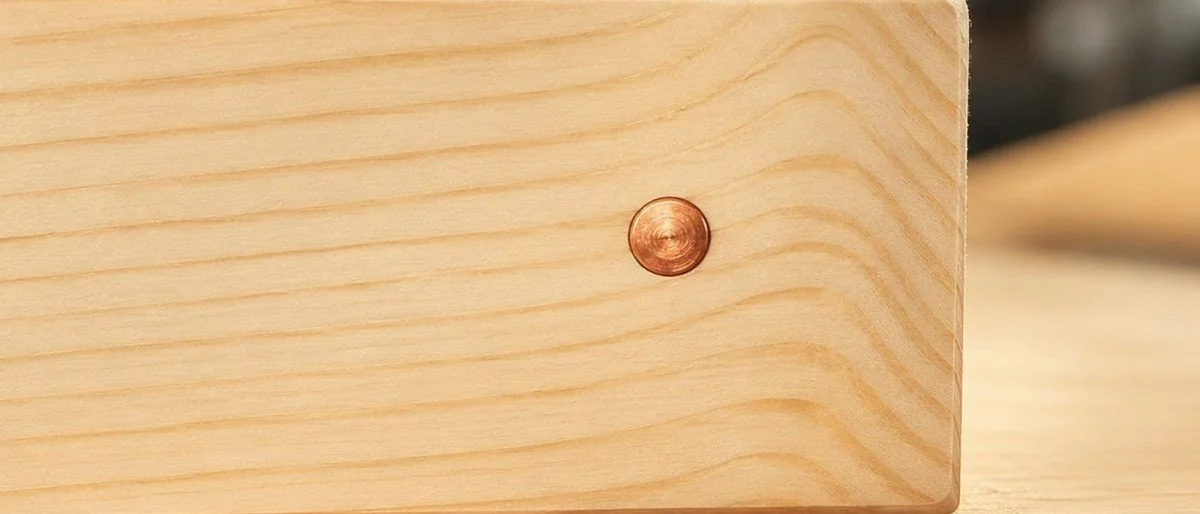
We make the wooden Russian pyramid ourselves, in our own workshop. The frame is put together with copper screws, with the thread cut by hand into solid copper. The top is wood, fixed with copper pins we also make ourselves, and finished with copper sheet. So a wooden pyramid still has copper in it, right where the edges meet.


Brass: the golden option
Brass is an alloy of copper and zinc. It is more yellow than copper, almost gold-colored, and it tarnishes less quickly. That's why you see brass mostly in small, decorative pyramids. If you love the color of copper but not the way it darkens, choose brass or lacquered copper.
Glass and crystal: closed and clear
A glass pyramid is not a frame but a closed shape, with four walls the light shines through. The best known stands in Paris: the glass pyramid of the Louvre, designed in 1989 by the architect I. M. Pei, with almost exactly the slope of Giza. At home you'll see small pyramids of glass or crystal, such as rock crystal or amethyst. They often sit on a desk or a windowsill, as a paperweight or because people simply love the stone.
Orgonite: resin with metal and crystal
Orgonite is cast resin with metal shavings and a crystal set into it, often in the shape of a pyramid. The word goes back to orgone, the name the psychiatrist Wilhelm Reich gave in the late 1930s to a life energy he believed he had discovered. The name orgonite came later. It is usually credited to Karl Hans Welz, who began casting metal in resin around 1990. Makers of orgonite say the combination of resin, metal and crystal brings energy into balance. That makes it a very different kind of pyramid from a copper frame: small, solid and cast.
Which material suits you?
- A small pyramid for a shelf or among plants: copper, lacquered or unlacquered.
- A pyramid to sit under: wood, or copper tube if you build it yourself.
- Something for your desk: glass, crystal or orgonite.
- Outdoors in the garden: unlacquered copper, which slowly turns green, or a durable wood.
Want to build a pyramid yourself, from copper tube or wood? Work out the lengths with the pyramid calculator.
Frequently asked questions
Why are most pyramids made of copper?
Copper conducts very well, bends easily and takes on its own color over the years. It also has a long bond with pyramids: the Egyptians cut the stones with copper tools.
Can a wooden pyramid stand outdoors?
Yes, but the type of wood matters. Teak and oak last longer outdoors than Douglas fir. Preferably don't set the pyramid directly on the ground, so the wood can dry.
What is the difference between copper and brass?
Brass is copper with zinc mixed in. It is more yellow and tarnishes less quickly. Copper is redder and over time takes on a brown and later green patina.
What is orgonite?
Cast resin with metal shavings and a crystal, often in a pyramid shape. The name refers to orgone, the life energy Wilhelm Reich wrote about.
You'll find the copper pyramids at Meditech Europe: the copper Cheops pyramid and the copper Russian pyramid. Living in the US? We ship there on request, just send us a message. More about the two shapes on the Cheops pyramid and the Russian pyramid.


Written by Marijn Makkes van der Deijl, who has been working with copper and pyramids since 2019.
Reviewed by Jolanda Kraaij, who oversees the sourcing and quality of the copper, on November 18, 2026.
Sources
- EN 350:2016. Durability of wood and wood-based products. Testing and classification of the durability to biological agents of wood and wood-based materials.
- Musée du Louvre. La Pyramide du Louvre, I. M. Pei, 1989.
- Reich, W. (1942). The Function of the Orgasm. Orgone Institute Press.
Last updated: November 2026