
The Golod Pyramids
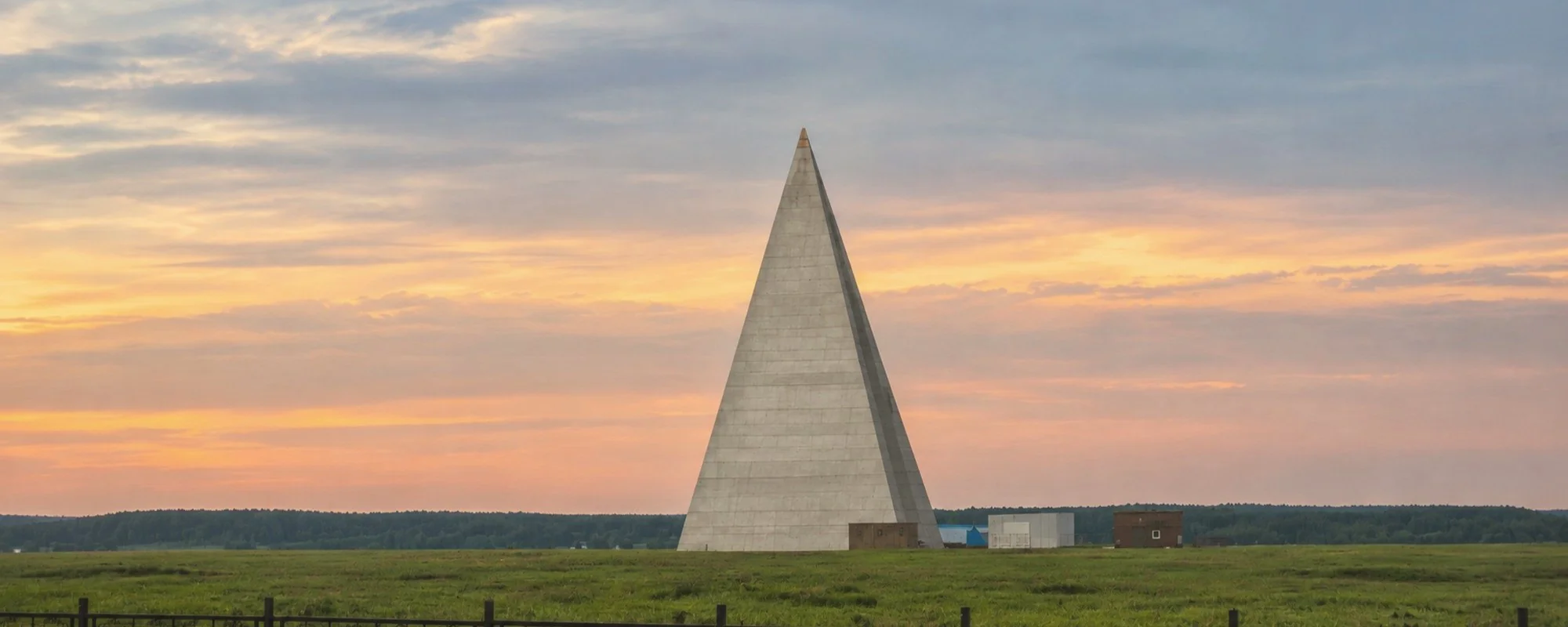
Talk about the Russian pyramid and you're talking about Alexander Golod. This engineer, who previously worked in the defense industry, had dozens of large pyramids built in Russia and neighboring countries from the 1990s onward. They are much steeper than those at Giza, and that shape has carried his name ever since.
The pyramid near Moscow
The best known stood on a hill along the highway from Moscow to Riga, about 19 miles (30 kilometers) outside the city. It was 144 feet (44 meters) tall, built of translucent plastic panels, and weighed about 55 tons. Inside lay sand and stones. The pyramid was finished at the end of 1999 and, according to a report from 2000, was Golod's seventeenth. Visitors came with bottles of water and took home stones that had spent time inside the pyramid. On May 29, 2017 the pyramid collapsed during a heavy storm over Moscow. According to Golod it was mainly wear: it had been built to last twenty years and had stood for more than seventeen. In July 2017 a temporary, smaller pyramid of 46 feet (14 meters) was put up in the same spot.
Why so steep
Golod chose a shape much taller than it is wide. In one of his patents the side of the base is exactly half the height. According to the American biophysicist Beverly Rubik, Russian researchers found that taller, steeper pyramids gave stronger effects. That steep, slender shape is what we now call the Russian pyramid. As it is usually made today, its faces rise at about 76 degrees, compared to almost 52 degrees at Giza.
What Golod says was measured
Golod and the researchers he worked with carried out all kinds of experiments in and around his pyramids. According to Golod, the research was supported by the Russian Academy of Medical Sciences. These are the results most often told:
- Seeds and harvest. Seeds that had spent one to five days inside the pyramid gave 20 to 100 percent higher yields in more than twenty crops.
- A column above the pyramid. According to Golod, radar stations 19 to 37 miles away saw a column of ions above the pyramid, about 6,600 feet tall and 1,600 feet wide. He says that column helps restore the ozone layer.
- Oil. On one oil field, according to the Moscow Academy of Oil and Gas, the viscosity of the oil dropped by 30 percent after a few days with pyramids. Golod applied for a patent on this in 1995 together with Belik and Mishura (WO 95/12052).
- Water that doesn't freeze. Bottles of water kept inside the pyramid stayed liquid for three winter months at minus 40 degrees, according to Golod. Only when shaken did they freeze within seconds.
- Weather and radiation. According to Golod, the weather around the pyramids becomes milder and the effects of radioactivity smaller.
- Crystals in space. Crystals that had been inside the pyramid went along to the Mir space station in 1998 and to the International Space Station in 2001, according to Golod.
- Health. Golod also said his pyramids were good for health.
The shape today
The Russian shape has become popular far beyond Russia: in the garden, among plants, and indoors as a slender pyramid that takes up little space. Meditech Europe sells it as the copper Russian pyramid and also makes it in wood itself. Living in the US? We ship there on request, just send us a message. How the Russian shape compares to other pyramids, you can see in the pyramid atlas.
Frequently asked questions
Who is Alexander Golod?
An engineer who previously worked in the defense industry and from the 1990s onward had dozens of large pyramids built in Russia and neighboring countries. The steep Russian pyramid is named after his shape.
How tall was the Golod pyramid near Moscow?
144 feet (44 meters). It stood about 19 miles outside Moscow, along the highway to Riga, and was made of translucent plastic panels. It collapsed in a storm in May 2017; in July 2017 a temporary pyramid of 46 feet was put up.
What is the difference between a Russian and a Cheops pyramid?
The Russian pyramid is much steeper: its faces rise at about 76 degrees, compared to almost 52 degrees at Giza. That makes it about twice as tall as it is wide.
What does Golod say about seeds?
According to Golod, seeds that had spent one to five days inside the pyramid gave 20 to 100 percent higher yields in more than twenty crops. In our own garden trial we looked at vegetables under and next to a pyramid.

Written by Marijn Makkes van der Deijl, who has been working with copper and pyramids since 2019.
Sources
- Meduza (May 30, 2017). Ураган разрушил пирамиду Голода в Подмосковье сразу после языческого обряда [Hurricane destroys Golod pyramid near Moscow].
- 360.ru (July 3, 2017). Восстановлена пирамида Голода на Новорижском шоссе [Golod pyramid on Novorizhskoe highway restored].
- Lambroschini, S. (2000). Russia: New Cult Of Pyramid Energy Draws Believers. Radio Free Europe/Radio Liberty.
- Belik, A. G., Golod, A. E. and Mishura, S. V. (1995). Process for improving the efficiency of crude oil extraction and processing. Patent application WO 95/12052.
- Golod, A. E. Patent RU 2149039 (proportions of the pyramid).
- ABO Company. Pyramids (Golden Section) research in Russia by Alexander Golod. English description of the research.
- Rubik, B. (2016). Interactions of pyramidal structures with energy and consciousness. Cosmos and History 12(2), 259–275.
- Kernbach, S. (2013). Unconventional research in USSR and Russia: short overview. arXiv:1312.1148.
- Wikipedia (2026). Alexander Golod.
Last updated: November 2026